
The conventional framework for women's diamond watches has been built on a single design assumption: more brilliance communicates more value. Stones are layered into bezels, crowded onto dials, and multiplied across cases in a format that equates coverage with quality. PASCAL's expanded range of PASCAL women's diamond watches takes a different position, one the brand describes as Controlled Brilliance — a design approach in which diamonds are placed not to maximize surface luminosity, but to define the spatial composition of the watch.
This is not a stylistic preference. It is a structural argument about how a watch should communicate. In the Controlled Brilliance framework, a diamond marker on a dial carries meaning through its position and its proportion, not through its proximity to adjacent stones. The spacing between elements, the relationship between the diamond's scale and the dial's surface area, and the depth at which each stone is set relative to the case plane are all active design decisions — not finishing choices made after the watch has already been composed.
The range of women's diamond watches at PASCAL is built around oval and geometric dial silhouettes, certified Swiss quartz movements, and 316L stainless steel cases. Stones are IGI-certified lab-grown diamonds, and documentation confirming cut, clarity, and color ships with every watch. That documentation is not incidental to the product — it is part of what makes the design argument legible. A watch that presents diamonds as precision-placed, structurally integrated elements needs those elements to be verifiably consistent, and IGI certification provides that verification.
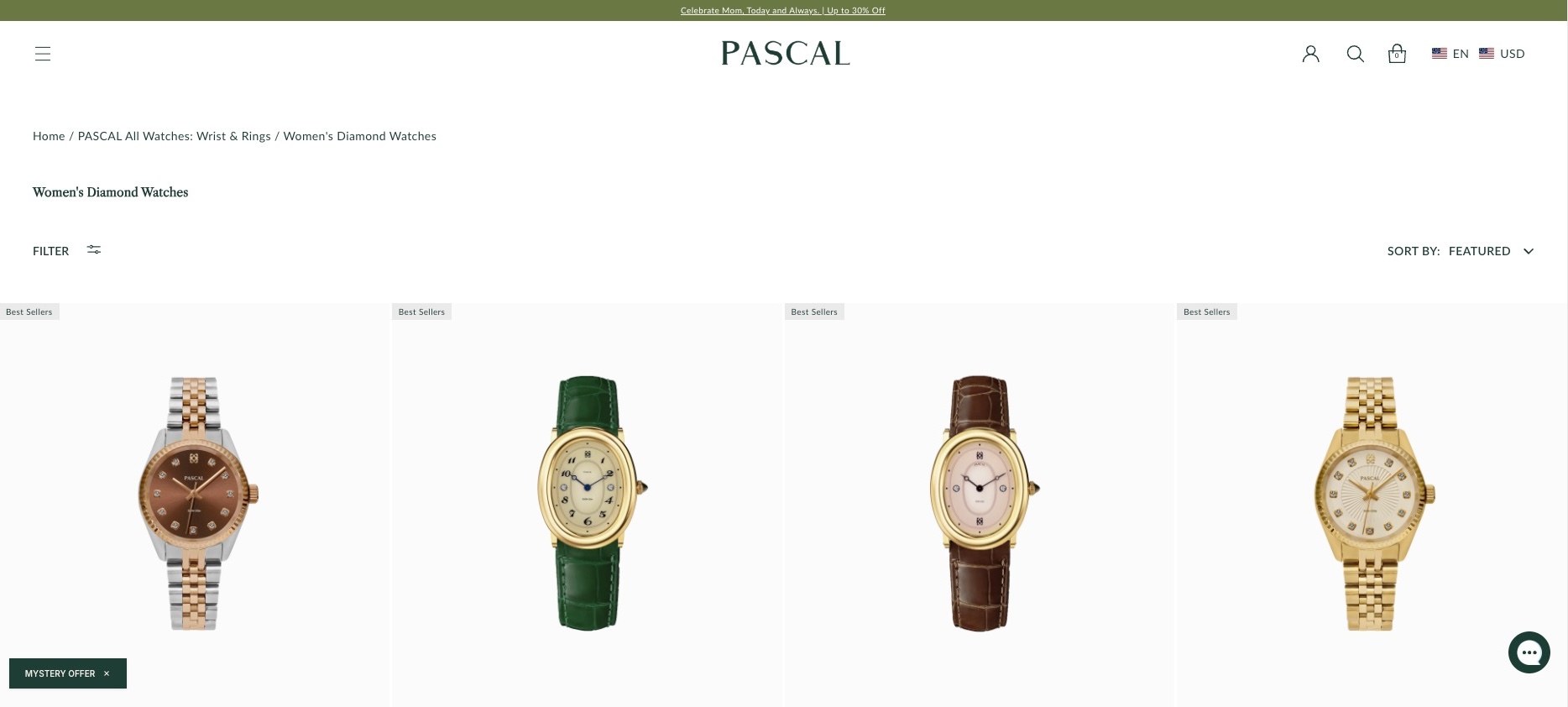
Within the PASCAL Timeless watch collection, this design language is expressed through oval dial formats where certified diamond markers trace the hour positions at intervals that give the dial a rhythmic visual structure. The markers do not cover the dial — they organize it. The result is a composition where the eye moves across the watch surface in a defined sequence, oriented by diamonds rather than distracted by them. The sapphire crystal glass above the dial adds a controlled reflection layer, softening the stone's output rather than amplifying it, and giving the overall face a quality of restrained luminosity that reads differently at different distances and under different light conditions.
Lab-grown diamonds contribute to this approach in a way that mined stones do not always allow. The consistency of lab-grown diamond production — repeatable cut geometry, stable clarity grades, predictable reflective behavior — means that a design specification written for one stone can be reliably executed across every unit in a production run. For a watch where the design argument depends on spatial precision and compositional consistency, that repeatability matters. The PASCAL Paradoxe diamond watch collection demonstrates this at the level of case geometry: angular case transitions, brushed and polished surface contrasts, and diamond-set indices positioned to create fixed points of controlled illumination within a dial that otherwise absorbs and redirects light.
The consumer this design addresses is not defined primarily by price range or occasion. The modern minimalist, the design-aware professional, and the collector who approaches fine jewelry as a system of considered objects rather than a display of accumulated value share a common framework: they read the watch as a composed object first and a status signal second. For that audience, a dial with three precisely placed certified diamonds at structurally significant positions communicates more than a bezel paved with undocumented stones at maximum coverage.
All watches in the women's collection ship with IGI stone documentation, Swiss quartz certified movements, sapphire crystal glass, and 316L stainless steel cases. The full collection is available at pascaldesign.com.
###
For more information about PASCAL, contact the company here:
PASCAL
Snow
collab@pascaldesign.com
170 S La Brea Ave, Los Angeles, CA 90036
United States